Concept Development
The motor concept is usually driven by the ballistician, although to be effective the ballistician must have a basic understanding of structures, heat transfer, and manufacturability.
The most important initial design driver is the exhaust plume requirement (min smoke, reduced smoke, or smoky), as this will dictate the propellant formulation class. Plume requirement is often competitive with the total impulse requirement as highly aluminized (smoky) propellants have the highest specific impulse while min smoke propellants have the lowest. Highly aluminized propellants also have the highest flame temperature. This will affect all the insulation thicknesses in the bulkhead, case, and nozzle (meaning that grain volumetric loading is lower, trading off some of the higher specific impulse gains).
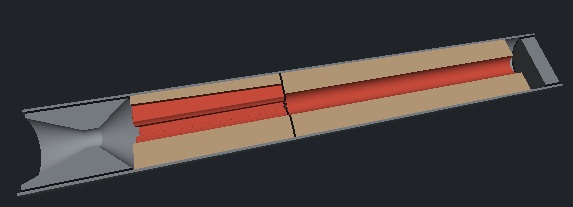
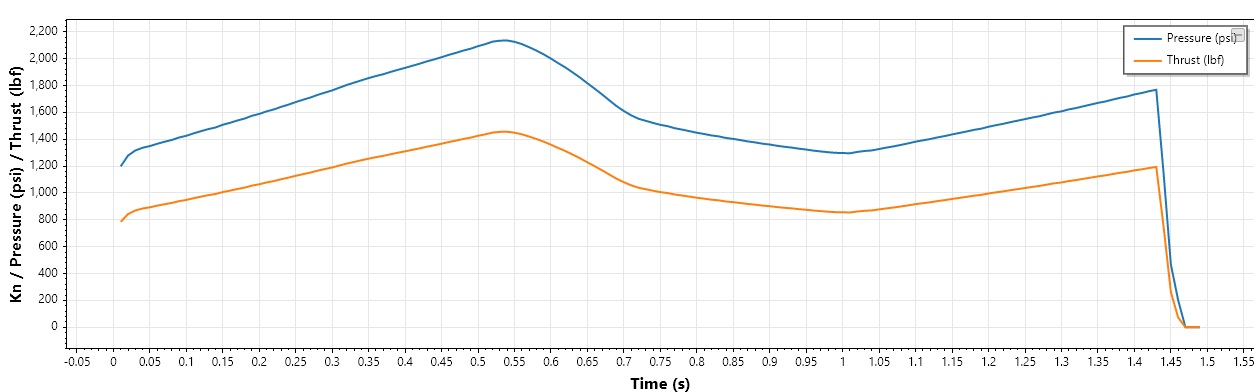
A neutral thrust (F/t) curve with a rapid rise to some minimum pressure is often desirable. Excessively progressive or regressive curves are structurally inefficient, as the wall thickness of the motor case is driven by peak pressure, not average pressure. There are only a few propellant grain geometries that will generate neutral curves. F/t curves are driven by the initial propellant grain surface area and can sometimes be improved with an ejectable nozzle plug.
The action time requirement will drive propellant burn rate, (effective) grain web thickness, and nozzle throat diameter (and therefore peak case pressure and therefore case wall thickness).
At the end of the concept development exercise, the ballistician will present the proposed concept to the broader design team for input. If acceptable, the next step is interior ballistic modeling.
During this step, the ballistician uses a computer program to predict the thrust/time (F/t), pressure/time (P/t) curves, action time, total impulse, and other motor ballistic parameters. Inputs to the ballistic model include:
-
Propellant burn rate coefficient and exponent (at ambient and temperature extremes)
-
Grain geometry, including assumed OD
-
Gamma (ratio of constant pressure/constant volume (Cp/Cv) heat capacities)
-
Molecular weight of combustion products.
-
Propellant density
-
Nozzle dimensions
The burn rate coefficient and exponent can only be determined experimentally, i.e., they cannot be reliably computed. A strand burner, step motor or small test motors are used to do this. Rocket motor companies maintain a catalogue of propellant formulations for which the coefficient and exponent are known. These parameters can be adjusted to some degree by propellant formulation changes.
Some parameters needed for ballistic and later for heat transfer analysis, like gamma, flame temperature, molecular weight of the combustion products, sonic velocity at case pressure and others are obtained from the propellant formula using a thermodynamic program. These include Pro-PEP, THERM, CHEETAH, and others.
Note that the outside diameter of the grain is initially assumed, as it is a function of case wall thickness and insulation thickness, which are not known at the outset. Once the initial ballistic analysis is complete, the case pressure can be used for structural and heat transfer analysis. One these are done, a revised grain diameter can be determined and the ballistic calculation rerun. This process is repeated until a design that meets requirements is created.
Privacy Policy
Web site and all contents Copyright Explosives Consulting LLC. All rights reserved.


